Hail is a capacity problem disguised as a measurement problem. Thousands of vehicles need assessing in the same week, by a workforce that cannot expand at the same speed, using a method that takes an hour per vehicle and varies with whoever performs it.
For insurers
Cycle time
Sixty to ninety minutes per vehicle becomes around fifteen, and the result is already digital.
Consistency
One measurement standard across every vehicle, region and assessor, which makes leakage measurable rather than assumed.
Surge capacity
Capacity scales with devices and operators, not fixed installations, which is the shape hail events actually have.
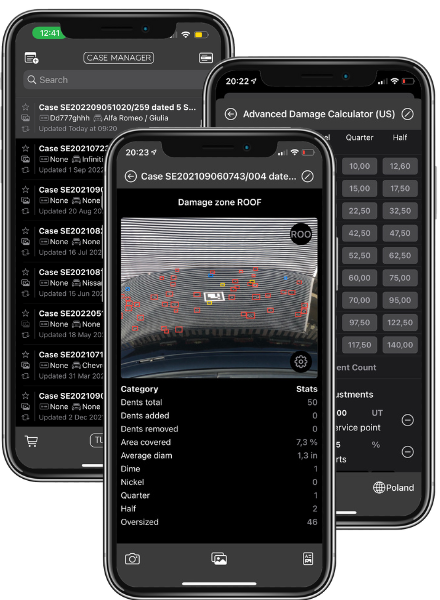
Standardised statistics per damage zone.
You keep control of the commercial decision
We do not price repairs and we do not want to. The assessment can stop at a standardised dent count per panel zone and pass that into your estimating system, where your rates, your matrix and your agreements already live.
Where you prefer the calculation to happen in the assessment itself, the matrix, cost adjustments and remove and install items are configured to your specification and held under your enterprise licence.
This matters for governance as much as for commercials. An automated measurement that also decides the payout is difficult to defend. An automated measurement that feeds a system you already control is not.
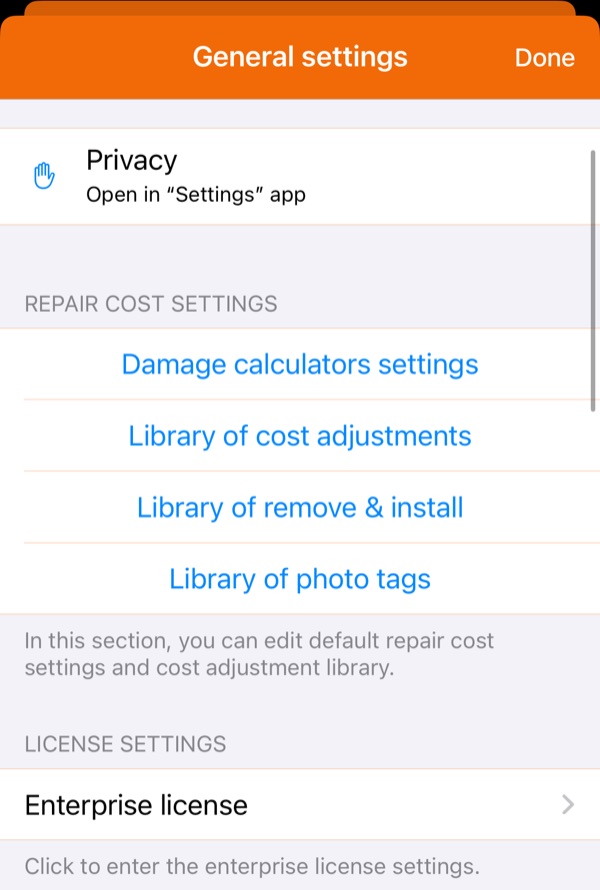
Calculators, cost adjustments and licence settings, configured per customer.
Operating models
In-house assessors
Your own staff, on managed devices, producing assessments directly into your claims system.
Partner and dealer networks
Repair networks and dealerships work under your account and in your format, so an external assessment is not a different kind of assessment.
Evidence and audit
Every assessment keeps the photographs and per zone measurements it was derived from, so any figure in the claim file can be traced back to what was actually captured. Our second product, currently in development, extends this to the integrity of the evidence itself by checking images for manipulation and inconsistency before they are trusted. See products.
Getting started
Most insurers begin with a bounded pilot on a defined set of claims, on their own calculation matrix, running alongside the existing process so the two results can be compared directly. That comparison is the only evidence worth having, and we would rather you generate it than take our word for the numbers.
Start with a comparison, not a commitment.
We will scope a pilot against your own claims and your own matrix, and you decide on the evidence it produces.